
The Next American Revolution
The Associational Freedom Of The Founders
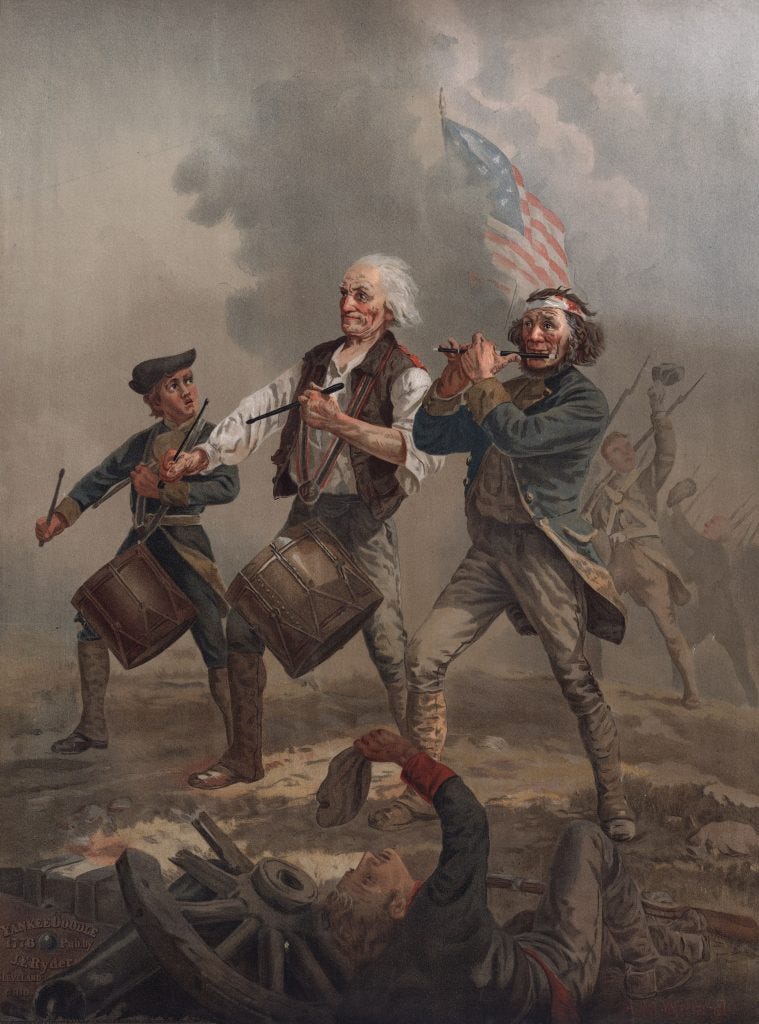
One must marvel at the audacity of what the Founders accomplished. If we ever hope to renew their spirit we should not only look at their words (which we love to quote and argue about), but also at the surrounding context of their lives.
This context is a forgotten power, the seed that allowed the colonies to sprout up geniuses and great men like weeds, and the reason they could experiment with a new kind of government and a new form of nation: that is the context of associational freedom.
Without this as part of our own life experience, we look at the Founders like a medieval peasant overwhelmed at the ruins of long dead Roman Greatness, or the modern conspiracy theorist marveling at the pyramids and concluding it must’ve been aliens.
Defining Associational Freedom
The Founders swam in an ocean of associational freedom: they saw no contradiction between the idea of a man being free and that same man entangled in a social web of manners, expectations, relationships, customs, obligation, duty, and inherited identity.
Washington and Jefferson and the like were great men, but they were also products of a society that prepared them to be great. The Founders bore arms for their community in militias, made written commitments to their churches for service, administration or mutual aid. They engaged in reciprocal economic obligation, helping neighbors with tasks too big for any one man, who in turned helped them. Perhaps help is too weak a word to convey the stakes. Reciprocal economic obligation kept them all alive.
Their education was not just transmission of knowledge but a transmission of character, stature and being from one generation to another. Their work and career were products of apprenticeship and close contact.
These men attended town halls, but not as we do now, as individuals expressing a single opinion, hoping perhaps for a viral moment; they went because they were held to account if they didn’t. Sure, it was voluntary, but, if you were a man of character and honor, it was not optional.
Many men of that time did opt out of these obligations and “voluntary” associations but you don’t read about them in the history books.
The Founders’ associational freedom was not all candies and bunnies, but deadly serious. Because they were tied so closely together they could inflict punishments and ostracize if covenants were broken or expect such to be inflicted upon them if they betrayed trust. Even their duels were an associational code, designed to involve others and usually, though not always, de-escalate interpersonal conflict.
Long before they gathered in Independence Hall, long before John Hancock delivered the first John Hancock, these men had been forged in a crucible of a thousand associations, they had exercised jurisdiction over every facet of their life. They proved themselves self-governed in every possible way.
And they demanded to the King of Great Britain that it was their inalienable right and freedom to continue to live so.
Severing Freedom From Association
All modern political parties and philosophies have violently severed association away from freedom.
Broadly speaking, the Left defines freedom as the right of every man, woman and child to define their “own concept of existence, of meaning, of the universe, and of the mystery of human life.” 1
In order to make this a reality for every individual human being, government, policy and our laws must reach inside every relationship, in between every human contact and establish itself inside every institution to ensure that everyone’s own concept of existence is honored as much as possible. Like a kind of ever present referee shielding THE ONE from stifling obligation.
Broadly speaking, the Right doesn’t disagree with this definition of freedom, only by what mechanism it is achieved. Instead of government coercively reaching inside every relationship, which the Right abhors, they are perfectly OK with the market doing the exact same thing. The Right holds as sacred the freedom to enter into as many transactions as one likes, no matter how far it takes them from local association. Like a kind of ever present siren, calling out to THE ONE to flee obligation for the pleasures of the shore.
For both, fidelity to self, above all.
Self-governance, transmission of being, the associational development of character and spirit out the window, just another piece of litter on the side of the road.
Even though we quote them to justify our politics, the Founders would not recognize either version of modern freedom as such.
The Next Revolution
While the Founders arose to power out of the context of local association, modern political figures and commentators arise because we have no local association. They pop into existence online or in an election to the support of millions; and the day before they were nothing to anyone, never having proved themselves capable of governance.
The most successful ones are not so much manipulators and liars as they are the natural consequence of the loss of meaningful relationships and local power. Modern political leaders become the receptacles of the emotional commitment of tens of millions of community-less people (us) who desperately desire someone to do something; to pass a law, to make a ruling, to change a policy so we can go on Freedom-ing in our preferred fashion.
It feels something like having power to us, something like “winning”. But as we celebrate the 250th anniversary of America’s independence, it’s worth remembering that’s not how the Founders won.
They won in the years and decades before by being someone important locally, by being bound up in weighty social and moral commitments. They won in the thankless time invested in transmission of character. They won by first claiming jurisdiction and exercising governance over all the small things within their sphere.
So when the hour called for great men, great men were there to answer.
Of course, we cannot easily recreate the forms of associational freedom that were common in the 18th century. Many of them are illegal (duels) and lack a modern social context (obligatory town halls). If this is how great, freedom loving men are made, then what is to be done besides mourn their absence?
Perhaps the audacity and the bravery to invest in new forms of associational freedom is itself the Next American Revolution, and the surest way to recapture the Spirit of 1776.
To go up against the king of our day, those false forms of freedom which seduce us, we’ll need to follow in the Founders’ footsteps and lay claim, piece by piece to self-governance over the spiritual, economic, relational, cultural and educational aspects of our lives.
It’s far easier to ask the politician to do it, or to attempt to build immediate large-scale parallel institutions to do the battle for you. But there is no skipping the reps of associational freedom.
And there is also no manual on how to do this other than to bring back into the sphere of your contacts as many of the functions of government and market that you and they can handle.
It will start small, but in time the Next American Revolution will find us standing on Bunker Hill and building a distinct local culture with other families.
Riding to Lexington and Concord to be a part of a fraternity with stakes and obligations.
Crossing the Delaware to educate and apprentice the next generation in both career and character.
And then signing our name in Independence Hall and declaring to the world that we are ready to self-govern again, like the Founders before us.
It is now just as it was then; to do this we must all hang together, or surely we will hang separately.
“Build The Village” is the premier newsletter for men who desire to lead in their homes, in their community and in the work they do.
The Challenge: Work With Me
There’s nothing to join but what you build. I work with men who are ready to build. Not another online brotherhood but a real village, today, where you live. The goal is to turn you into the local pillar you’re capable of being.
When you work with me, I will have high expectations of you. As I have for myself. By challenging you in these things, I am not a friend nor a therapist nor a mentor. But maybe a spotter who has put in a few more reps.
So if you are willing to be challenged, if you’re ready to push toward a new kind of personal record, start here.
From US Supreme Court Justice Anthony Kennedy’s majority opinion in Planned Parenthood vs Casey, 1992.
What many people miss in the 2022 Dobbs ruling, which sent abortion back to the states, was the language around the 1992 Casey ruling.
Thomas and Alito, speaking for the majority, said that the Casey ruling was wrong when it said you have the right to “define your own concept of existence”.
They appealed instead to the concept of Ordered Liberty, a fancy way to say Tradition.
And they said everything that they would rule on in the future would be approached and tested by Ordered Liberty. (Including this week’s rulings).
Effectively nullifying the “you create your own existence” from Casey.